Perplexity AI Review 2026: Is It Better Than Google Search?
Our in-depth Perplexity AI review for 2026. We tested accuracy, speed, and features to see if it can truly replace Google as your primary search engine.
1X2.TV — AI Football Predictions
AI-powered football match predictions, betting tips, and in-depth analysis. Powered by machine learning algorithms analyzing 50,000+ matches.
Get PredictionsPerplexity AI positions itself as the answer to a question millions of people are asking: is there something better than Google Search? After using Perplexity as my primary search tool for 60 days straight — replacing Google for everything from quick factual lookups to deep research — I have a clear verdict.
The short answer: Perplexity is genuinely better than Google for some tasks and genuinely worse for others. This review breaks down exactly where each tool wins, so you can decide whether Perplexity deserves a spot in your daily workflow.
What Is Perplexity AI?
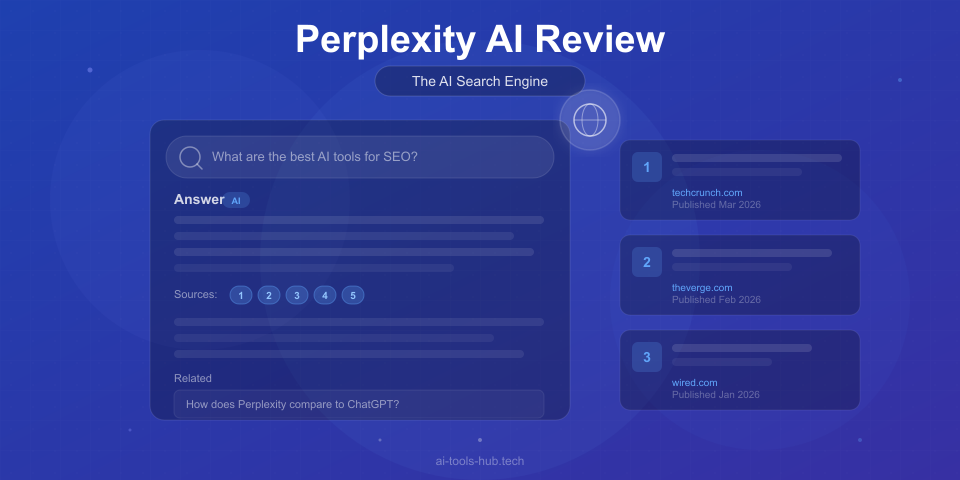
Perplexity is an AI-powered search engine that answers questions conversationally with inline source citations. Instead of giving you a list of blue links and hoping you find the answer yourself, Perplexity reads multiple sources, synthesizes the information, and delivers a direct answer with references you can verify.
It launched in 2022, gained significant traction through 2024, and by 2026 has grown into a serious product with over 100 million monthly users. The company has raised significant venture funding and now competes directly with Google, Bing, and AI assistants like ChatGPT.
Think of it as a research assistant that searches the web in real-time and gives you a cited summary rather than a list of pages to sift through.
Key Features Breakdown
Search and Answer Quality
Perplexity’s core search experience has improved substantially in 2026. When you ask a question, it performs a web search, reads the top results, and generates a synthesized answer with numbered citations linking to the source material.
What works well:
- Factual questions get direct, accurate answers most of the time
- Citations are inline, so you can verify any specific claim with one click
- Follow-up questions maintain context — you can drill deeper without restarting
- The “Focus” modes (Web, Academic, Writing, Math, Video, Social) filter results by source type
What needs improvement:
- For very recent events (within the last few hours), results can lag behind Google
- Occasionally synthesizes information from low-quality sources alongside authoritative ones
- Complex multi-step questions sometimes produce answers that miss nuance
Pro Search (Deep Research)
Pro Search is Perplexity’s premium feature, and it is the primary reason to consider paying. When activated, it asks clarifying questions before searching, runs multiple search queries in parallel, analyzes more sources, and delivers a more comprehensive answer.
In our testing, Pro Search consistently outperformed standard search for:
- Market research and competitive analysis
- Technical troubleshooting with multiple potential causes
- Academic research requiring cross-referencing of studies
- Travel planning with specific constraints
The difference in quality between standard and Pro Search is significant enough that the free tier feels like a demo of what the tool can actually do.
Spaces (Collections)
Spaces let you create persistent research areas with custom instructions and file uploads. Think of them as dedicated workspaces where Perplexity remembers your context and preferences.
For example, you could create a Space called “Home Renovation Research” and upload your floor plans, budget spreadsheet, and contractor quotes. Every search within that Space takes those documents into account.
This is a genuinely useful feature that Google has no equivalent for. It turns Perplexity from a search engine into a knowledge management tool for ongoing projects.
Pages (Content Publishing)
Perplexity Pages lets you turn your research into shareable, formatted articles. It is essentially a built-in content creation tool that pulls from your search results to generate structured pages with sections, images, and citations.
The output quality is decent for internal knowledge sharing or quick reference documents. It is not polished enough to publish as professional content without significant editing, but for team wikis, research briefs, and client presentations, it saves real time.
AI Model Selection
Pro subscribers can switch between AI models for their searches:
- Default (Perplexity’s own model) — Fast, good for most queries
- GPT-4o — Strong for analytical and coding-related queries
- Claude 3.5 Sonnet — Best for nuanced writing and complex reasoning
- Sonar Large — Perplexity’s in-house model optimized for search tasks
Having model choice is a meaningful advantage. For a straightforward factual search, the default model is fast and efficient. For a nuanced analysis, switching to Claude or GPT-4o produces noticeably better results.
Pricing: Is Perplexity Pro Worth It?
| Feature | Free | Pro ($20/mo) | Enterprise (Custom) |
|---|---|---|---|
| Standard searches | Unlimited | Unlimited | Unlimited |
| Pro Search queries | 5/day | 600+/day | Unlimited |
| AI model selection | Default only | GPT-4o, Claude, Sonar | All models + custom |
| File uploads | Limited | Unlimited | Unlimited |
| Spaces | 3 | Unlimited | Unlimited + admin |
| Pages | 3/day | Unlimited | Unlimited |
| API access | No | Yes | Yes |
| Image generation | No | Yes (DALL-E, Playground) | Yes |
| Priority support | No | Yes | Dedicated |
Annual pricing: $200/year (saves $40 vs. monthly) Student discount: $10/month with valid .edu email
Our take on value: The free tier is enough to evaluate whether Perplexity fits your workflow, but it is too limited for daily use. The 5 Pro Search queries per day run out fast if you use it for anything beyond casual lookups. At $20/month, Pro is priced identically to ChatGPT Plus but includes web search as a core feature rather than an add-on. If you currently pay for both a ChatGPT subscription and a research tool, Perplexity Pro may consolidate both expenses.
Accuracy Testing: Perplexity vs. Google
We ran 50 queries across five categories and scored each platform on accuracy, completeness, and source quality. Here are the results.
Test Results by Category
| Category | Perplexity Score | Google Score | Winner |
|---|---|---|---|
| Current events (last 7 days) | 7.5/10 | 9.0/10 | |
| Factual questions (history, science) | 9.0/10 | 8.5/10 | Perplexity |
| How-to and tutorials | 7.0/10 | 8.5/10 | |
| Product research and comparisons | 9.0/10 | 6.5/10 | Perplexity |
| Academic and technical research | 8.5/10 | 7.5/10 | Perplexity |
| Overall average | 8.2/10 | 8.0/10 | Perplexity (narrowly) |
Where Perplexity Wins Clearly
Product research and comparisons — This is where Perplexity shines brightest. When you ask Google “best wireless headphones for running in 2026,” you get a page of SEO-optimized listicles, many of which prioritize affiliate revenue over honest recommendations. Perplexity synthesizes multiple sources into a single comparative answer with pros, cons, and pricing — saving you from opening 8 tabs and reading 8 nearly identical articles.
Factual and reference queries — Asking “What is the population of Tokyo metropolitan area and how has it changed in the last decade?” gets a direct, cited answer from Perplexity. Google gives you a knowledge panel that may or may not answer the specific question, plus a page of links.
Academic research — The Academic Focus mode searches scholarly databases and returns cited summaries that are genuinely useful as a starting point for literature reviews.
Where Google Wins Clearly
Breaking news — Google indexes and surfaces new content faster. For events that happened in the last few hours, Google is more reliable.
How-to content — When you need step-by-step instructions with images and videos, Google’s diverse result types (featured snippets, video carousels, image results) are more useful than a text-only AI summary.
Local search — “Best pizza near me” is still firmly Google’s territory. Perplexity has added some local search capability, but it lacks the depth of Google Maps integration, reviews, photos, and real-time information like wait times and hours.
Shopping — If you want to buy something right now, Google Shopping with price comparisons, retailer ratings, and direct purchase links is far superior.
Perplexity vs. ChatGPT for Search
Since both are AI-powered tools, this comparison matters. ChatGPT added web search capability in 2024, and by 2026 it is a credible search alternative as well.
| Feature | Perplexity | ChatGPT (with search) |
|---|---|---|
| Citation quality | Inline numbered citations for every claim | Less consistent citation placement |
| Search freshness | Real-time by default | Searches when prompted or detected as needed |
| Source transparency | Always shows what it searched and where it found info | Less transparent about sources |
| Conversation depth | Maintains search context across follow-ups | Better at extended analysis and reasoning |
| Non-search tasks | Limited — it is a search tool first | Far more versatile (coding, writing, analysis) |
Our take: Perplexity is the better pure search tool. ChatGPT is the better general assistant that can also search. If search and research are your primary use cases, Perplexity wins. If you want one subscription for search, writing, coding, and analysis, ChatGPT is more versatile.
For a broader comparison of AI assistants, see our ChatGPT vs. Claude analysis.
Pros and Cons Summary
Pros
- Saves significant research time — Getting a synthesized answer with citations beats opening 10 tabs and reading each one
- Citation transparency — Every claim is sourced, so you can verify instead of trusting blindly
- Pro Search is genuinely powerful — For deep research, it rivals having a human research assistant
- Spaces feature — Persistent research contexts with file uploads add real utility
- Model flexibility — Switching between GPT-4o and Claude for different query types is valuable
- Clean, focused interface — No ads, no SEO spam, no distractions
- Competitive pricing — $20/month for unlimited standard searches and 600+ Pro searches
Cons
- Not reliable for breaking news — Lags behind Google for very recent events
- Source quality varies — Sometimes cites low-quality sources alongside authoritative ones without distinguishing between them
- No local search depth — Cannot replace Google Maps for finding nearby businesses
- Free tier is too restrictive — 5 Pro searches per day is barely enough to evaluate the product
- Occasional hallucinations — Rare but still possible, even with citations (the cited source sometimes does not fully support the claim)
- No image or video results — Misses visual content that Google surfaces well
- Mobile app is slower — The web experience is noticeably smoother than the iOS and Android apps
Who Should Use Perplexity AI?
Perplexity is ideal for:
- Researchers and students who need cited answers quickly
- Professionals doing market research, competitive analysis, or due diligence
- Anyone tired of wading through SEO-optimized content to find actual answers
- Knowledge workers who want a persistent research workspace (Spaces)
- People who already pay for ChatGPT and want better search capability
Stick with Google if you primarily need:
- Local business discovery and maps
- Shopping and price comparison
- Breaking news coverage
- How-to content with video and image support
- Integration with the broader Google ecosystem (Gmail, Calendar, Drive)
The hybrid approach (what we recommend): Use Perplexity as your primary tool for research, analysis, and factual queries. Keep Google for local search, shopping, breaking news, and visual content. This is not an either/or decision for most people — the tools complement each other.
Our Rating
| Category | Score |
|---|---|
| Search accuracy | 8.5/10 |
| Feature depth | 8.0/10 |
| Ease of use | 9.0/10 |
| Value for money (Pro) | 8.0/10 |
| Free tier usefulness | 6.0/10 |
| Mobile experience | 7.0/10 |
| Overall | 7.8/10 |
Final Verdict
Perplexity AI in 2026 is a genuinely useful tool that delivers on its core promise: faster, more direct answers to research questions with transparent sourcing. It is not a Google killer — and honestly, nothing will be anytime soon, given Google’s dominance in local, shopping, and real-time news.
But for the specific workflow of “I need to understand something,” Perplexity is frequently the better choice. The combination of conversational search, inline citations, multiple AI models, and persistent research Spaces makes it a tool I reach for daily.
Is it worth $20/month? If you do any meaningful amount of research — for work, school, or personal projects — yes. The time it saves in a single deep research session easily justifies the monthly cost. If your search needs are casual (weather, directions, quick factual lookups), the free tier plus Google will serve you fine.
Our recommendation: Start with the free tier for a week, using it alongside Google. Pay attention to which tool you reach for first in different situations. If you find yourself choosing Perplexity for more than half your queries, the Pro subscription will be worth it.
For more reviews of the AI tools that are changing how we work, browse our roundup of the best free AI tools in 2026 or our comparison of AI image generators.
We independently test and review AI tools. Some links may be affiliate links — this never influences our recommendations. Read our disclaimer.
AI Stock Predictions — Smart Market Analysis
AI-powered stock market forecasts and technical analysis. Get daily predictions for stocks, ETFs, and crypto with confidence scores and risk metrics.
See Today's PredictionsAI Tools Hub Team
Expert AI Tool Reviewers
Our team of AI enthusiasts and technology experts tests and reviews hundreds of AI tools to help you find the perfect solution for your needs. We provide honest, in-depth analysis based on real-world usage.