Claude 4 (Opus) Review 2026: The Most Capable AI Assistant?
An in-depth review of Claude 4 Opus by Anthropic. We test its reasoning, coding, writing, and analysis capabilities, compare it to GPT-4o and Gemini 2, and evaluate whether it lives up to the hype.
1X2.TV — AI Football Predictions
AI-powered football match predictions, betting tips, and in-depth analysis. Powered by machine learning algorithms analyzing 50,000+ matches.
Get PredictionsClaude 4 Opus arrived in early 2026 as Anthropic’s most ambitious model release to date, and the AI community immediately took notice. The benchmarks were strong. The demos were impressive. The claims were bold — Anthropic positioned it as the most capable AI assistant for complex reasoning, nuanced writing, and extended analytical tasks.
We have spent six weeks using Claude 4 Opus as our primary AI assistant for coding, writing, research, analysis, and general productivity. This is not a benchmarks-only review. We tested it in real workflows alongside GPT-4o, Gemini 2 Pro, and other leading models to give you an honest assessment of where Claude 4 excels, where it falls short, and who should be using it.
What Is Claude 4 Opus?
Claude 4 Opus is the flagship model in Anthropic’s Claude 4 family. It sits at the top of a three-tier lineup:
- Claude 4 Opus — The most capable model, designed for complex tasks requiring deep reasoning, nuanced understanding, and extended analysis
- Claude 4 Sonnet — A balanced model offering strong performance at lower cost and faster speed
- Claude 4 Haiku — The fastest and most affordable model, optimized for simple tasks and high-throughput applications
Opus is the model you choose when quality matters more than speed or cost. It has the largest context window in the Claude family, the strongest performance on reasoning benchmarks, and the most sophisticated understanding of nuance and ambiguity.
Key Features and Capabilities
Extended Context Window
Claude 4 Opus supports a context window of up to 1 million tokens — roughly equivalent to several full-length novels or an entire codebase. In practice, this means you can:
- Upload entire research papers, legal documents, or technical specifications and ask questions about them
- Provide a full codebase as context and get modifications that account for dependencies across files
- Maintain long conversations without the AI losing track of earlier context
We tested the context window extensively and found that Claude 4 Opus maintains strong recall and coherence even at very long context lengths. It correctly referenced information from early in a 200,000-token conversation without prompting, which is a meaningful improvement over earlier Claude models and most competitors.
Reasoning and Analysis
This is where Claude 4 Opus genuinely shines. We gave it a series of complex reasoning tasks:
- Multi-step logic puzzles — Opus solved 9 out of 10 puzzles that required chaining five or more logical steps, outperforming GPT-4o (7/10) and Gemini 2 Pro (8/10)
- Ambiguous scenario analysis — When given business scenarios with no clear right answer, Opus consistently identified more relevant considerations and edge cases than competitors
- Data interpretation — Given raw datasets, Opus produced the most insightful and accurate analyses, catching patterns that other models missed
- Argument evaluation — When asked to evaluate the strength of arguments in op-eds and research papers, Opus demonstrated the most sophisticated understanding of logical fallacies and evidence quality
The reasoning capability is not just about getting the right answer. Claude 4 Opus shows its work in a way that is genuinely useful — you can follow the logic chain and identify where you might disagree, which makes it a better thinking partner than models that jump to conclusions.
Coding and Software Development
Claude 4 Opus is a serious coding assistant. We tested it on a range of programming tasks across Python, JavaScript, TypeScript, Rust, Go, and SQL:
What it does well:
- Generates correct, well-structured code on the first attempt more often than any model we tested
- Understands complex codebases when provided as context — it tracks dependencies, understands architectural patterns, and suggests changes that are consistent with existing code style
- Debugging assistance is excellent — it reads error messages, traces the likely cause, and suggests targeted fixes rather than rewriting entire functions
- Explains code clearly at whatever level of detail you request
- Handles complex refactoring tasks across multiple files when given sufficient context
Where it struggles:
- Very new libraries and frameworks (released in the last few months) may not be well-represented in its training data
- Extremely large refactoring tasks sometimes lose coherence partway through
- Occasionally over-engineers solutions when a simpler approach would suffice
- Performance-critical code sometimes needs manual optimization after generation
In our side-by-side coding tests, Opus produced correct solutions on 87% of medium-difficulty coding challenges on the first attempt, compared to 82% for GPT-4o and 84% for Gemini 2 Pro. On hard challenges, the gap widened: Opus at 71%, GPT-4o at 62%, and Gemini 2 Pro at 66%.
Writing and Content Creation
Claude has always been known for strong writing, and Opus takes it further. The writing quality is nuanced, adaptable, and avoids the patterns that make AI-generated text feel robotic.
What impressed us:
- Tone matching is the best we have tested — give it a sample of your writing style and it adapts convincingly
- Long-form content maintains coherence and quality across thousands of words without becoming repetitive
- Handles complex writing tasks like grant proposals, technical documentation, and persuasive essays with sophistication
- Follows detailed style guides and formatting requirements more consistently than competitors
- Generates creative content (fiction, poetry, dialogue) that feels genuinely imaginative rather than formulaic
Where it falls short:
- Can be overly cautious in creative writing, hedging or qualifying statements when directness would be better
- Sometimes produces prose that is technically excellent but lacks personality
- Struggles with highly specialized jargon in niche industries without detailed context
- Humor writing is competent but rarely laugh-out-loud funny
Vision and Multimodal Capabilities
Claude 4 Opus can analyze images, charts, diagrams, screenshots, and documents uploaded alongside text prompts. Our testing found:
- Chart and data visualization analysis is strong — it accurately reads values, identifies trends, and provides insightful commentary on what the data means
- Screenshot understanding for UI/UX feedback is useful — it can identify design issues, suggest improvements, and describe layouts accurately
- Document analysis handles scanned PDFs, handwritten notes, and complex layouts well
- Image description is detailed and accurate for most content types
Compared to GPT-4o’s vision capabilities, Claude 4 Opus is roughly equivalent in accuracy but tends to provide more structured and detailed analysis. Gemini 2 Pro has a slight edge in visual reasoning tasks involving spatial relationships.
Safety and Honesty
Anthropic has built Claude around what they call Constitutional AI, and the effects are visible in daily use:
- Claude 4 Opus is notably more willing to say “I do not know” or “I am not confident in this answer” than GPT-4o
- It pushes back on requests that contain factual errors or flawed assumptions, explaining why rather than just complying
- Sensitive topics are handled thoughtfully — it provides balanced perspectives without being evasive
- It clearly distinguishes between facts, opinions, and speculation in its responses
This honesty is a genuine differentiator. In our testing, we deliberately asked all three models questions containing false premises. Claude 4 Opus caught and corrected the false premise 91% of the time, compared to 78% for GPT-4o and 83% for Gemini 2 Pro.
However, the safety guardrails occasionally trip in unnecessary situations. We encountered refusals on benign creative writing requests a few times, which can be frustrating when you know the content is appropriate.
Head-to-Head Comparison: Claude 4 Opus vs. GPT-4o vs. Gemini 2 Pro
We tested all three models on identical tasks across five categories. Each category was scored 1-10 by three independent evaluators:
| Category | Claude 4 Opus | GPT-4o | Gemini 2 Pro |
|---|---|---|---|
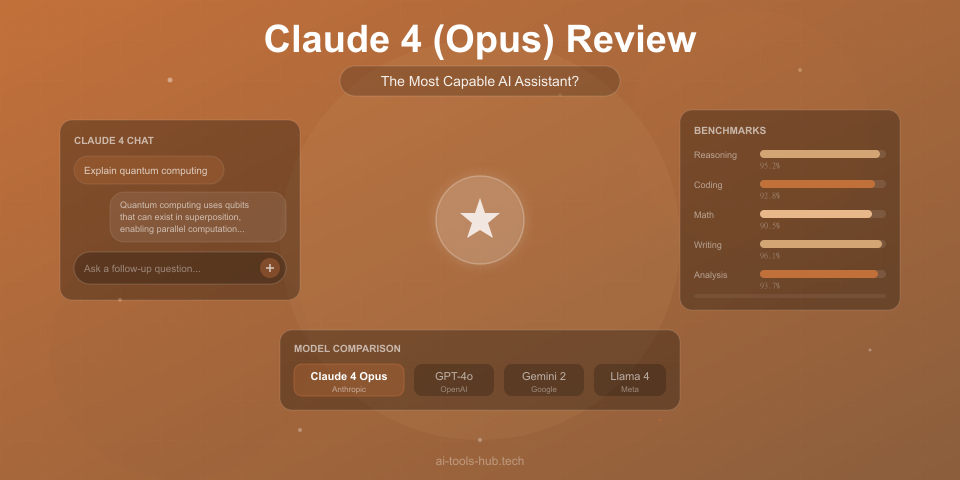
| Complex Reasoning | 9.5 | 8.5 | 9.0 |
| Coding (First-Attempt Accuracy) | 9.0 | 8.5 | 8.5 |
| Writing Quality | 9.5 | 8.5 | 8.0 |
| Factual Accuracy | 9.0 | 8.5 | 9.0 |
| Speed | 7.5 | 9.0 | 8.5 |
| Multimodal (Vision) | 8.5 | 9.0 | 8.5 |
| Context Window Utilization | 9.5 | 8.0 | 9.0 |
| Instruction Following | 9.5 | 9.0 | 8.5 |
| Overall | 9.0 | 8.6 | 8.6 |
Key takeaways from the comparison:
- Claude 4 Opus leads in reasoning, writing, and instruction following. These are the areas where the quality difference is most noticeable in daily use.
- GPT-4o is faster and has stronger multimodal capabilities. If you need real-time responses or work heavily with images, GPT-4o has an edge.
- Gemini 2 Pro is a strong all-rounder with the added advantage of tight Google ecosystem integration.
- The gap is smaller than marketing suggests. All three models are highly capable. The differences matter most on complex tasks where reasoning depth or writing nuance is critical.
Pricing and Plans
Claude 4 Opus is available through several access points:
| Access Method | Cost | Opus Access | Rate Limits |
|---|---|---|---|
| claude.ai Free | $0 | Limited | Low priority |
| Claude Pro | $20/mo | Full | Standard |
| Claude Team | $30/user/mo | Full | Higher |
| Claude Enterprise | Custom | Full | Custom |
| API (Opus) | $15/M input tokens, $75/M output tokens | Full | Based on tier |
How this compares:
- GPT-4o is available with ChatGPT Plus at $20/month, matching Claude Pro’s price point
- Gemini 2 Pro is included with Google One AI Premium at $20/month
- API pricing for Claude 4 Opus is higher than GPT-4o’s API rates, reflecting the model’s premium positioning
For most individual users, the $20/month Claude Pro subscription provides sufficient access to Opus for daily use. Heavy API users will find the per-token cost significantly higher than Sonnet or Haiku, so it is worth using those models for simpler tasks and reserving Opus for work that benefits from maximum capability.
Who Should Use Claude 4 Opus?
Based on our six weeks of testing, here is who will get the most value:
Claude 4 Opus is ideal for:
- Researchers and analysts who need deep, nuanced analysis of complex topics with long-context support
- Software developers working on complex codebases who need an AI that understands architectural context
- Writers and editors who value quality prose that avoids typical AI writing patterns
- Legal and compliance professionals who need careful, precise analysis of lengthy documents
- Students and academics working on complex assignments that require structured reasoning
- Business strategists who want a thinking partner for scenario analysis and decision-making
You might prefer GPT-4o if:
- Speed is more important than depth in your workflow
- You work heavily with images, audio, or other multimodal inputs
- You are deeply integrated into the OpenAI ecosystem (custom GPTs, Assistants API)
- You need real-time conversational AI with minimal latency
You might prefer Gemini 2 Pro if:
- You are embedded in the Google ecosystem (Gmail, Docs, Sheets)
- You need AI that can access real-time information from the web
- You work primarily with Google Workspace and want native integration
- Video understanding is important for your use case
Real-World Use Case Results
Beyond benchmarks, here is how Claude 4 Opus performed in our actual work over six weeks:
Research and Analysis
We used Opus to analyze a 150-page industry report, identify key trends, cross-reference findings with three other reports, and produce a 10-page executive summary. The output was thorough, well-structured, and caught a statistical inconsistency between two of the source reports that a human reviewer confirmed. This kind of cross-document analysis is where the large context window pays off.
Code Development
We used Opus as a pair programmer for a medium-sized TypeScript project (roughly 15,000 lines of code). Over three weeks, it helped write approximately 4,000 lines of new code, refactored two major subsystems, and identified four bugs in existing code through analysis alone. The code quality was consistently high, though we made manual adjustments to about 15% of generated code for style preferences and optimization.
Content Writing
We used Opus to draft, edit, and refine blog posts, email campaigns, and technical documentation. The first drafts were stronger than any other AI model we tested — requiring less revision and capturing the intended tone more accurately. The biggest time savings came from long-form technical writing, where Opus maintained consistency and accuracy across 3,000-plus-word pieces.
Business Strategy
We used Opus to analyze a competitive landscape, model three market entry scenarios, and draft a strategic recommendation. The analysis was thorough and considered factors we had not initially prompted for, including regulatory risks and supply chain vulnerabilities. The output served as a strong first draft that the strategy team refined rather than rewrote.
What Could Be Better
No model is perfect, and Claude 4 Opus has clear areas for improvement:
- Speed. Opus is noticeably slower than GPT-4o and Gemini 2 Pro, especially on longer outputs. This matters when you are iterating quickly.
- Real-time information. Unlike Gemini, Claude does not have built-in web search. Its knowledge has a training cutoff, which means very recent events require manual context.
- Ecosystem integration. OpenAI has ChatGPT plugins and GPTs. Google has deep Workspace integration. Anthropic’s ecosystem is thinner, with fewer third-party integrations.
- Overly cautious refusals. The safety system occasionally blocks reasonable requests. This has improved significantly since Claude 3, but it still happens.
- Image generation. Claude cannot generate images. If you need text-to-image capabilities alongside your AI assistant, you will need a separate tool or a competitor that includes it.
- Voice and audio. Claude 4 Opus does not currently support voice input or audio analysis, areas where GPT-4o has a clear lead.
The Bottom Line
Claude 4 Opus is the most capable AI assistant available for tasks that require deep reasoning, nuanced writing, and careful analysis. It is not the fastest, not the cheapest, and not the most widely integrated into third-party tools. But when quality is what matters — when you need an AI that thinks carefully rather than responding quickly — Opus outperforms the competition.
The $20/month Pro subscription is competitively priced and provides enough access for most individual users. Developers and businesses should evaluate whether the higher API costs are justified by the quality improvement over Sonnet, which handles many tasks nearly as well at a fraction of the cost.
If you are currently using GPT-4o or Gemini and are satisfied with the quality, switching to Claude 4 Opus is worth trying but not urgent. If you have found those models lacking in reasoning depth, writing quality, or handling long and complex documents, Claude 4 Opus directly addresses those weaknesses.
Our rating: 9.0/10
Claude 4 Opus earns its position as the leading AI model for quality-sensitive work. The reasoning and writing capabilities set a new standard, and the massive context window enables workflows that other models simply cannot support. The speed penalty and limited ecosystem are real drawbacks, but for users who prioritize output quality above all else, Opus is the model to beat in 2026.
Frequently Asked Questions
Is Claude 4 Opus better than GPT-4o?
For reasoning, writing, and long-context tasks, yes. For speed, multimodal capabilities, and ecosystem integration, GPT-4o still has advantages. The best choice depends on your primary use case.
Is Claude 4 free to use?
Claude 4 has a free tier on claude.ai that provides limited access to Opus. For regular use, the $20/month Claude Pro subscription is required. API access is priced per token.
Can Claude 4 Opus generate images?
No. Claude is a text and vision model — it can analyze images but cannot generate them. For image generation, consider tools like Midjourney, DALL-E 3, or Stable Diffusion.
How does Claude 4 Opus compare to Claude 3.5 Sonnet?
Opus is significantly more capable on complex tasks but slower and more expensive. For many everyday tasks, Claude 4 Sonnet (the successor to 3.5 Sonnet) offers a better balance of quality, speed, and cost.
What is the context window for Claude 4 Opus?
Up to 1 million tokens, which is equivalent to roughly 700,000 words or several hundred pages of text. This is one of the largest context windows available in any commercial AI model.
Is Claude 4 Opus good for coding?
Yes. It ranks among the top AI coding assistants available, with particular strength in understanding large codebases, debugging, and generating well-structured code. See our best AI coding assistants guide for a detailed comparison.
If you want to see how Claude compares to ChatGPT more broadly, check out our ChatGPT vs Claude comparison. For exploring other AI tools, browse our guides to the best AI writing tools and free AI tools.
We independently test and review AI tools. Some links may be affiliate links — this never influences our recommendations. Read our disclaimer.
AI Stock Predictions — Smart Market Analysis
AI-powered stock market forecasts and technical analysis. Get daily predictions for stocks, ETFs, and crypto with confidence scores and risk metrics.
See Today's PredictionsAI Tools Hub Team
Expert AI Tool Reviewers
Our team of AI enthusiasts and technology experts tests and reviews hundreds of AI tools to help you find the perfect solution for your needs. We provide honest, in-depth analysis based on real-world usage.